Surgical Lamp Buyer’s Guide
Send inquiry now
OR Light Types, LED Benefits & Specialty Needs | MECANMED
Your Complete Handbook for Operating Room Lighting Selection
Surgical lamps, also known as operating lights or surgical lights, are essential components in healthcare facilities, providing optimal illumination for medical procedures, surgery, and examinations. Selecting the right surgical lamp is crucial to ensure accurate visualization, minimize eye strain, and enhance patient safety. In this guide, we break down the key considerations and share our expert recommendations to help global buyers make informed decisions.
Why Surgical Lamp Quality Impacts Outcomes
Precision illumination in operating rooms reduces surgeon eye fatigue by 38% and decreases procedure errors by 27% (WHO Clinical Reports). Whether equipping new ORs or upgrading existing facilities, this guide covers critical factors:
✅ Mounting configurations (ceiling/wall/mobile)
✅ Light source technologies (LED vs. Halogen vs. Xenon)
✅ Specialty-specific lighting requirements (cardiac to dental)
✅ Lamp head configurations (single vs. dual)
Key Factors to Consider When Selecting a Surgical Lamp
1. Mounting Method
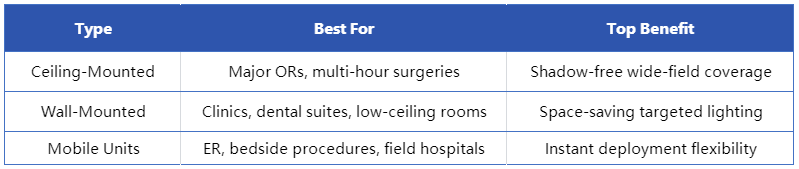
1) Ceiling-Mounted Surgical Lamps
Ceiling-mounted surgical lamps are fixed lamps installed on operating room ceilings, designed for optimal shadow-free illumination in standard surgical procedures.
Features:
- Overhead Illumination: Ceiling-mounted surgical lamps provide a broad and uniform illumination across the entire surgical field or examination area, reducing shadows and ensuring consistent lighting during procedures.
- Adjustability: Ceiling-mounted surgical lamps often offer flexibility with multi-arm systems for specific procedure requirements, ensuring optimal visualization for surgeons and medical staff.
- Space Efficiency: Ceiling-mounted surgical lamps free up valuable floor and wall space, providing more room for medical equipment and personnel.
Suitable for: large operating room and major surgery (e.g., general surgery, cardiac surgery, neurosurgery, orthopedic surgery, etc.)
2) Wall-Mounted Surgical Lamps
Wall-mounted surgical lamps are fixed auxiliary lamps attached to walls, providing targeted supplemental lighting for specialized or space-constrained surgical areas.
Features:
- Localized Illumination: Wall-mounted surgical lamps focus the light on specialized or space-constrained surgical areas, providing targeted illumination for procedures that require concentrated light in a particular region.
b) Adjustable Positioning: Wall-mounted surgical lamps provide precise, angled illumination for specialized procedures. - Compact Design: Wall-mounted surgical lamps, usually with compact design, minimize obstruction and provides ease of use in smaller specialized procedure rooms with limited ceiling support.
Suitable for: space-constrained rooms (e.g., clinics, dental/ophthalmic operating rooms, examination rooms, rooms with ceilings of insufficient load-bearing capacity or height) and minor surgery (e.g., minimally invasive surgery, endoscopic examination, outpatient debridement and suturing, etc.)
3) Mobile Surgical Lamps
Mobile surgical lamps are compact and movable units on wheeled stands for flexible emergency or on-site illumination.
Features:
- Mobility and Flexibility: Mobile surgical lamps allow easy relocation in different locations or between rooms.
- Ease of Use: Mobile surgical lamps are lightweight and easy to handle, facilitating efficient workflow and reducing strain on medical staff.
Suitable for: emergency use, outpatient clinics, patient bedside surgery and minor surgery (e.g., trauma emergency care, abscess drainage, etc.)
2. Light Source
1) Halogen Surgical Lamp
- Pros: low initial cost; good color rendering; familiar technology
- Cons: generating significant heat; short lifespan; high energy consumption; slow response
Suitable for: low- to mid-budget hospitals; short procedures; backup/emergency lamps
2) LED Surgical Lamps
- Pros: long lifespan; energy-efficient; low heat emission; adjustable color temperature and illuminance; good shadow control and focused illumination; excellent color rendering
- Cons: high initial cost; potential light decay issues;
Suitable for: operating rooms with high usage; high-precision surgery (e.g., cardiac surgery, neurosurgery, ophthalmic surgery, etc.); operating rooms requiring advanced control and flexibility
3) Xenon Surgical Lamps
- Pros: high-intensity illumination; excellent color rendering; good depth of field
- Cons: short lifespan; high energy consumption (requiring cooling systems); startup delay; bulky in size
Suitable for: specialized deep cavity surgery (e.g., cardiovascular surgery, orthopedic joint replacement, etc.); short-duration high-brightness requirement
3. Type of Surgery
Critical Parameters by Procedure
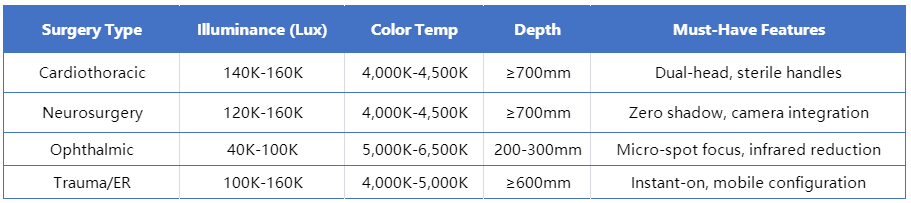
Pro Tip: For laparoscopic suites, prioritize compatibility with endoscopic towers
1) Cardiovascular & Thoracic Surgery
- Recommended illuminance: 140,000~160,000 lux
- Recommended color temperature: 4,000K~4,500K
- Recommended CRI: ≥ 95
- Recommended depth of illumination: ≥ 700mm
- Dual-head systems
2) Neurosurgery
- Recommended illuminance: 120,000~160,000 lux
- Recommended color temperature: 4,000K~4,500K
- Recommended CRI: ≥ 95
- Recommended depth of illumination: ≥ 700mm
- Long-duration lighting; cool light emission; camera integration; minimal color distortion
3) Orthopedic Surgery
- Recommended illuminance: 100,000~160,000 lux
- Recommended color temperature: 4,000K~5,000K
- Recommended CRI: ≥ 90
- Recommended depth of illumination: ≥ 600mm
- Broad and niform field lighting
4) General Surgery
- Recommended illuminance: 120,000~160,000 lux
- Recommended color temperature: 4,000K~4,500K
- Recommended CRI: ≥ 90
- Recommended depth of illumination: ≥ 600mm
- Wide and adjustable light field size; sterile handle for in-procedure adjustments
5) Obstetrics & Gynecology Surgery
- Recommended illuminance: 60,000~120,000 lux
- Recommended color temperature: 3,500K~4,500K
- Recommended CRI: ≥ 85
- Recommended depth of illumination: 300~500mm
- Low heat emission; multiple light sources
6) ENT & Ophthalmic Surgery
- Recommended illuminance: 80,000~120,000 lux (ENT), 40,000~100,000 lux (ophthalmic)
- Recommended color temperature: 4,000K~5,000K
- Recommended CRI: ≥ 90
- Recommended depth of illumination: 200~400mm
- Narrow and focused light field; minimal shadow; low heat emission
7) Laparoscopic & Minimally Invasive Surgery
- Recommended illuminance: 60,000~120,000 lux
- Recommended color temperature: 4,000K~5,000K
- Recommended CRI: ≥ 90
- Recommended depth of illumination: 300~500mm
- Compatibility with endoscopic/video systems; low heat emission;
8) Plastic & Reconstructive Surgery
- Recommended illuminance: 80,000~120,000 lux
- Recommended color temperature: 4,000K~5,000K
- Recommended CRI: ≥ 95
- Recommended depth of illumination: 200~400mm
- Excellent shadow control; minimal heat emission
9) Dental & Maxillofacial Surgery
- Recommended illuminance: 80,00~50,000 lux
- Recommended color temperature: 5,000K~6,500K
- Recommended CRI: ≥ 85
- Recommended depth of illumination: 200~300mm
- Precision light focus / small light field; shadow-free illumination; sterile handle or autoclavable components;
10) Trauma & Emergency Surgery
- Recommended illuminance: 100,00~160,000lux
- Recommended color temperature: 4,000K~5,000K
- Recommended CRI: ≥ 90
- Recommended depth of illumination: ≥ 600mm
- Rapid adjustability and positioning; stable and shadow-free illumination; sterile handle for in-procedure adjustment; fast warm-up / instant-on lighting
4. Number of Lamp Heads
1) Single-head Surgical Lamps
- Pros: lower initial cost; compact design; easier installation and operation
- Cons: limited coverage; more shadows; less redundancy; less flexibility
Suitable for: small/constrained operating rooms; primary hospitals or outpatient clinics; emergency departments or trauma rooms; used as backup lighting in operating rooms; veterinary surgery; minor surgery (e.g., dermatology, ENT, dental, plastic surgery)
2) Dual-head Surgical Lamps
- Pros: better illumination coverage; enhanced redundancy; improved depth and angle lighting; flexible positioning
- Cons: higher initial cost; taking more space; more complex to operate; installation complexity
Suitable for: deep cavity surgery; large operating rooms; high-volume surgical centers; surgery requiring video integration or cameras; multi-surgeon teams or teaching hospitals; major surgery (e.g., cardiac, neurosurgery, orthopedic, general surgery)
Why Partner with MECANMED?
End-to-End Surgical Lighting Solutions
Lifecycle Management:
- 5-year warranty with <24hr response time
- Recalibration & LED module replacement services
Global Logistics:
- DDP shipping to 150+ countries
- Local technical support hubs in 12 countries